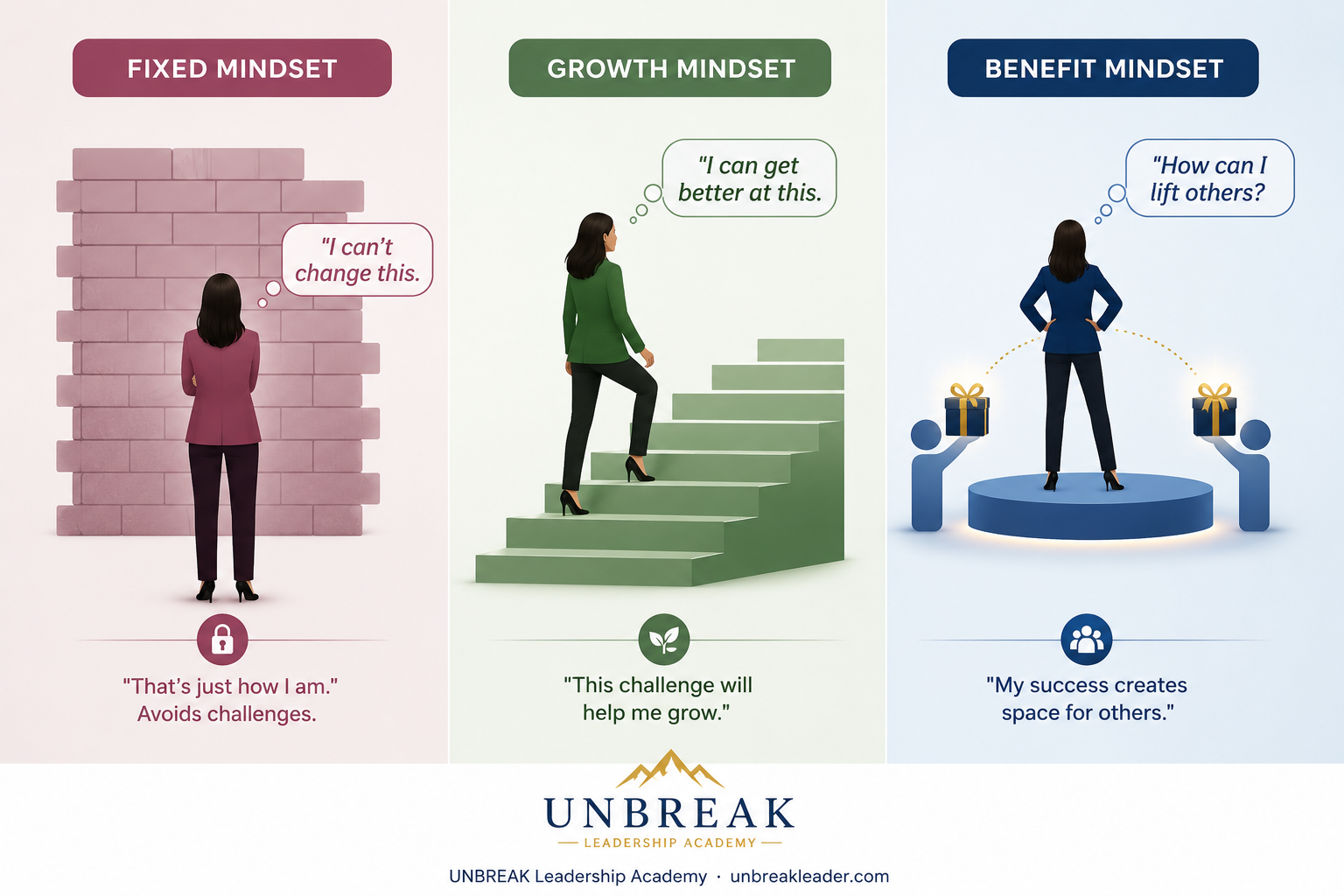
You've heard about fixed mindset versus growth mindset.
You probably nodded along. Maybe you even took notes.
And then you went back to working harder, proving yourself more, and wondering why the next level still feels just out of reach.
Here's the truth nobody says out loud: knowing about mindset and actually shifting yours are two completely different things. And for high-performing, highly driven women, the gap between those two things is exactly where ambition goes quiet.
Fixed Mindset: The One You Know
A fixed mindset tells you that your intelligence, your talent, your leadership ability — they're fixed. You either have them or you don't. Failure isn't feedback. It's evidence.
Most high achievers think they've outgrown this one. They haven't.
It doesn't show up as "I can't do this." It shows up as:
Staying silent in the room because your idea isn't perfect yet
Volunteering for everything so nobody questions your value
Hesitating to apply for the role because you only meet 8 out of 10 criteria
Fixed mindset in high performers doesn't look like giving up. It looks like over-preparing, over-delivering, and quietly shrinking.
Growth Mindset: Necessary, But Not Enough
Carol Dweck's research on growth mindset changed how we think about learning and resilience. The belief that ability can be developed through effort is genuinely powerful — and genuinely incomplete for where you're trying to go.
A growth mindset asks: How can I improve?
That's a good question. But it's still a question about you — your skills, your gaps, your development.
For women leaders ready to move from high performer to influential leader, that inward focus can become its own trap. You spend so much time improving yourself that you forget to claim your space, use your voice, and lead from where you already are.
Benefit Mindset: The One That Changes Everything
The benefit mindset — introduced by psychologist Paul Hansteiner — takes growth mindset one step further. It asks not just how can I improve, but: how can I contribute?
It shifts the question from what do I need to fix to what do I have to give.
This is the mindset shift that separates leaders who are perpetually preparing from leaders who are actively leading.
It sounds like:
"I don't need to have all the answers — I need to create the conditions for the right answers to emerge."
"My experience, my perspective, my story — these aren't things to minimize. They're things to deploy."
"I'm not waiting to be ready. I'm ready enough to start."
For driven women who have spent years proving their worth through performance, this is the most disruptive shift of all. Because it requires you to stop earning your seat and start owning it.